

Akio Saiki, Chairman, Japan-India Association (Public Interest Incorporated Foundation)
Beyond the feeling of unease. With respect, let's take the plunge.

Akitaka Saiki, Chairman, Japan-India Association (a public interest incorporated foundation)
■ Profile
He graduated from the University of Tokyo in 1976 and joined the Ministry of Foreign Affairs the same year. After serving as Director-General of the Asian and Oceanian Affairs Bureau, Ambassador Extraordinary and Plenipotentiary to India and Bhutan, and Vice Minister for Foreign Affairs (Political Affairs), he was appointed Vice Minister for Foreign Affairs in 2013. He retired in 2016. Since 2017, he has served as Chairman of the Board of Directors of the Middle East Research Institute, and since 2022, he has served as Chairman of the Board of Directors of the Japan-India Association.
"My first visit to India during my summer vacation as a junior high school student was like going to another world," says Akio Saiki, Chairman of the Japan-India Association. Saiki felt a strong sense of unease with the caste system, where occupations are determined by social status. He later became a diplomat, serving as Ambassador to India and Undersecretary of Foreign Affairs. We spoke with him about his encounter with India, his respect for the country, and the message he wants to convey to students.
During my summer vacation in junior high school, I visited India for the first time because my father had been transferred there. From the moment I stepped off the plane, I was shocked by a series of events. There were so many people, so many cows, and it was incredibly hot. The sanitary conditions were also not as good as in Japan. For a boy from a Japanese city, it was a completely different world.
It wasn't just the appearance of the town that surprised me. The staff working at my father's house each had their own strictly defined job. It was based on a caste system; if you dropped food during a meal, you weren't allowed to pick it up yourself. You had to call someone over, point to the floor, and they would scramble to pick it up. As a child, I felt a strong sense of unease.
The sense of time was completely different. In Japan, the Yamanote Line comes every few minutes, but in India, trains and buses don't follow schedules. When a bus finally arrives, people rush in and get on without hesitation. There are people who perceive time differently than we do. As a young boy, I learned this for the first time.
■The caste system, which I found unsettling, was also a testament to the wisdom of our ancestors.
Later, after talking to many people in India, my perspective changed. India has a population of over 14 billion, more than China. For these people to make a living, everyone must be able to find work. There are thousands of castes, and all are linked to work. The son of a shoemaker is a shoemaker, and so is his son. While it is difficult to take on other jobs, their own job is securely guaranteed. It is a kind of wisdom from our ancestors, who established social status based on occupation for the sake of social stability.
In present-day India, non-traditional jobs are increasing. Fields like IT are caste-independent, and many young people are succeeding through hard work and dedication. However, this doesn't mean the caste system has disappeared. While the constitution prohibits caste-based social discrimination, it doesn't reject the caste system itself.
When I returned as the ambassador to India, more than 40 years had passed since my childhood. Skyscrapers had sprung up, subways had been built, and the number of free-roaming cows had decreased. But that's only superficial. There's a lifestyle that hasn't changed for thousands of years, and that's what makes India India. Japan has also changed in many ways on the surface, but ultimately, the Japanese people haven't changed. You only understand that when you go abroad and experience it for yourself.
■The path to becoming a diplomat and the respect that I have cherished
I think my childhood experiences abroad were one of the reasons I aspired to become a diplomat. In the summer of my third year of university, when I started to seriously think about my future, those memories came flooding back. I wanted to do a job that would be useful to my country. With that in mind, I formed a study group with five classmates, studied for a year, and passed the diplomatic service exam in the summer of my fourth year.
There's something I've always valued when interacting with people from other countries: respect for them. If you have a negative impression of someone, it will immediately show through in your words and actions. Therefore, the best approach is to actively find their good points and praise them. I made sure to do this even when I was the ambassador to India. Almost no one gets angry when they're praised, and everyone appreciates it.
■You won't know until you go and live there.
There are many things about foreign countries that you can only understand by going there and living there. The India you see in books and on videos is a beautiful world. On the other hand, there is also the everyday reality that is not just that. Right next to the Taj Mahal, there are towns where people live in harsh conditions. Yet, it is India that both of these things are mixed together.
Some people who are stationed in India for work go there at their company's request, initially feeling hesitant. However, these people gradually get used to it and come to think that India and the Indian people aren't so bad. Of course, getting an upset stomach is something everyone experiences. However, very few people experience anything serious, so it might be best to go with the expectation that you might get sick.
I am now putting these experiences to good use as the chairperson of the Japan-India Association. The Japan-India Association is the oldest private friendship and exchange organization in Japan, established in 1903. The government sets the general framework under the treaty, and companies carry out the actual activities. The Japan-India Association plays a supporting role in deepening exchanges between Japan and India.
Therefore, we'd like to work with motivated students who are interested in India. We're looking for people who aren't just looking at India from Japan, but who are willing to actually go there and experience both the good and bad aspects of India.
■Message to students
How was the Japan you all live in created? I believe that the positive aspects of our current lives are the result of the hard work and efforts of generations of fathers, mothers, grandfathers, and grandmothers, each in their own field. The culture and traditions created by our ancestors have not faded away because they have value.
Sumo wrestling is said to have existed since the age of mythology, and different types of dashi (broth) have been created in various regions of Japan, and these traditions continue to thrive today. I want you to occasionally pause and remember that you are built upon such traditions. I believe it is the duty of young people to protect them and pass them on to the next generation. New things are important, but old things survive because they have value.
And I hope that young people will have a competitive spirit. If you ever have the opportunity to go to India, I urge you to take the plunge. Just set foot there, spend some time there, and see what it's like. I think that will be an important experience.
Interview conducted by Kenta Ito, 3rd year student at Waseda University, for Student Newspaper Online on August 1, 2026.
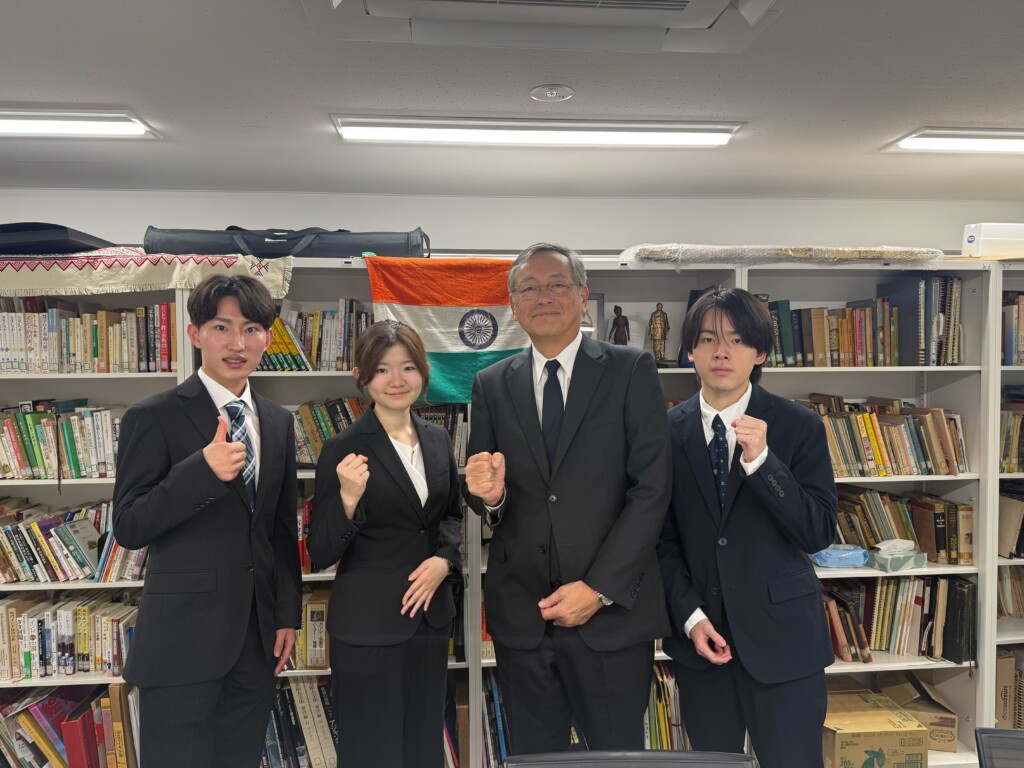
Kenta Ito (3rd year, Waseda University) / Emari Oike (1st year, Japan Women's University) / Kenhiko Yamada (1st year, Hosei University)


No comments yet.