

Yutaka Yoneyama, 5th President of Ritsumeikan Asia Pacific University (APU)
My study abroad experience was the starting point for me to break free from my shy and withdrawn self.
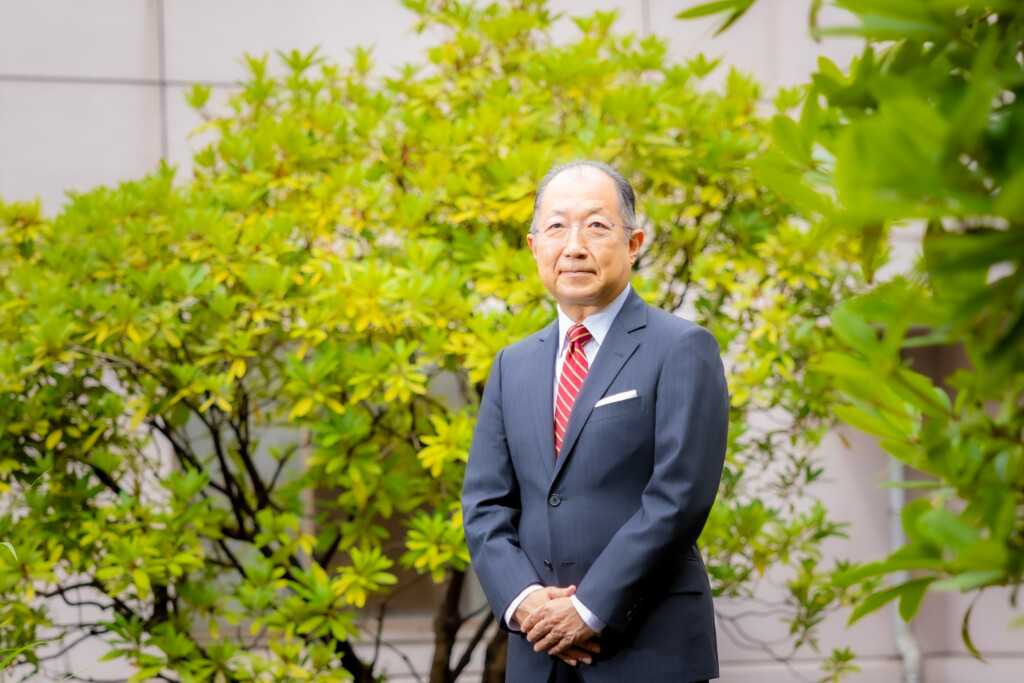
Hiroshi Yoneyama, 5th President of Ritsumeikan Asia Pacific University (APU)
■ Profile
Born in Tokyo in 1959. After graduating from the College of Arts and Sciences at the University of Tokyo, he obtained a Master of Arts in History from the University of Tsukuba. In 1991, he withdrew from the Graduate School of History at the University of California, Los Angeles (UCLA). After serving as an assistant at the College of Arts and Sciences at the University of Tokyo, an associate professor at Toyo Women's Junior College, and a professor at the Faculty of Letters, Ritsumeikan University, he joined Ritsumeikan Asia Pacific University as Vice President in 2020. He assumed his current position in January 2024. His specialties are American history and the history of Japanese immigrants.
APU, located in Beppu City, Oita Prefecture, was founded in 2000 with the concept of "three 50s" (50% international students, 50% foreign faculty, and students from over 50 countries/regions). Today, it has become a leading international university in Japan, attracting students from over 100 countries and regions. We interviewed President Yutaka Yoneyama about his passionate feelings for APU, his role as president, and his message to university students.
■What kind of student life did you have?
At university, I studied in the Faculty of Liberal Arts, researching Japanese Americans. Originally, I enrolled in the science stream, but I was troubled by what I call "the first year is boring." Then, a class called "International Relations" sparked my interest in humanities studies, and I decided to switch to the humanities. After that, on the recommendation of a senior student, I received a scholarship and studied abroad at UCLA (University of California, Los Angeles) for a year while still a student. Studying was certainly difficult, but during my time abroad, I had challenging experiences such as making decisions on my own and having to negotiate and resolve various troubles on my own. Furthermore, I interacted with students who had felt it was difficult to live in Japanese society, such as Japanese people who attended international schools and people with roots in both China and Japan. Through these encounters, I realized the diversity of human beings, and that knowledge was very useful in my research on Japanese Americans. Looking back now, I think my experience studying abroad in America was the starting point for me to break out of my shy, book-loving youth.
■Please tell us about your duties as president.
Before becoming president, I taught at the Faculty of Letters at Ritsumeikan University for 21 years. I had always been interested in APU because of its international learning opportunities, so when then-president Haruaki Deguchi invited me to become vice president, I said, "Yes, I'll go!" and decided to leave Ritsumeikan University and move to Oita.
The president, as the head of the university, primarily takes the lead in ensuring student learning and growth by gathering opinions within the university and making final decisions. One of APU's characteristics is that its campus is located in Beppu, Oita Prefecture, so most first-year students live in a student dormitory called "AP House." Approximately half of the students enroll in April and half in September, and half of the dormitory residents change every six months, so every semester we hold an event called "The President Stays Overnight," where the president stays in the dormitory with the students to deepen their interaction. This is also an important part of the president's job. In terms of public relations, we collaborate with high schools, cram schools, and companies to promote the strengths of APU students and broaden the scope of student recruitment, employment, and internship opportunities. In addition, we are discussing with faculty and staff what kind of university APU should be in 5 or 10 years, developing a medium- to long-term vision.
One of the new initiatives we are currently working on is discussions on how to provide APU's education to working professionals outside of the student body. At APU, we refer to the government's promotion of "reskilling," which involves learning new knowledge and skills, as "lifelong learning." We want to provide a system that goes beyond mere skill acquisition, allowing people of all ages and backgrounds to utilize university education and research for their own growth and to solve problems in their companies and communities. When I was teaching at Ritsumeikan University, I never imagined I would become president. But now, I've come to realize, "This is what I wanted to do," and I'm truly glad I became president.
■What kind of "new human society" will students create?
At APU, you can see students who grew up in Japan and students who came from abroad interacting on equal footing without either feeling out of place. I honestly felt that this was a new kind of human society, an amazing environment being created on this campus. Currently in Japanese society, opposition to foreigners is arising and debate is heating up. However, at APU, where about 50% of the students are international students, they are happily learning and striving to improve themselves together. I hope that Japanese people will also be convinced that this is something they can do. International exchange extends beyond the university to the entire Beppu region. Because APU students live here, they are contributing not only to hotels and restaurants, but also to inbound tourism in Beppu city as a whole.
It's often said that Japanese people can't succeed internationally because they don't take initiative, but I think that's only half true. When you hear the term "international student," you might imagine someone active and international, but that's not the case. There's a diverse group of people, from students from Myanmar and Indonesia who have been educated to not express their opinions clearly, to students from India and Pakistan who strongly assert their opinions. In an environment where about 50% of the faculty are foreign nationals, I feel that students are encouraged to value their own unique feelings and ways of thinking, which helps them develop and grow their "communicative" abilities—that is, their enjoyment of interacting and talking to people. If the right environment is provided, young people have the potential to spread their wings and succeed. When I look at APU students, their discussions are very lively, there's absolutely no ridicule like "pretentious" students, and there's a student culture of mutual support. I'm constantly having experiences that make me think about what kind of initiatives society as a whole should take to make the most of the potential of young people.
■Please give us a message for students
Students will be active in society for at least 50 or 60 years from now. What we see now is an unstable world with energy problems, climate change, the rise of AI, and conflicts, but beyond that, a future beyond what we adults can predict will surely come. At that time, having the resolve to deal with whatever happens and having the attitude to continue learning so that you can deal with whatever happens will be your greatest weapon. I hope you will respond positively to the changes that will come, even to the point of enjoying them a little, see them as opportunities for your growth, and maintain a learning attitude that says, "No matter what comes, I have the strength to overcome it."
Student Newspaper Online, July 26, 2026 Interview with Emari Oike, 1st year student at Japan Women's University
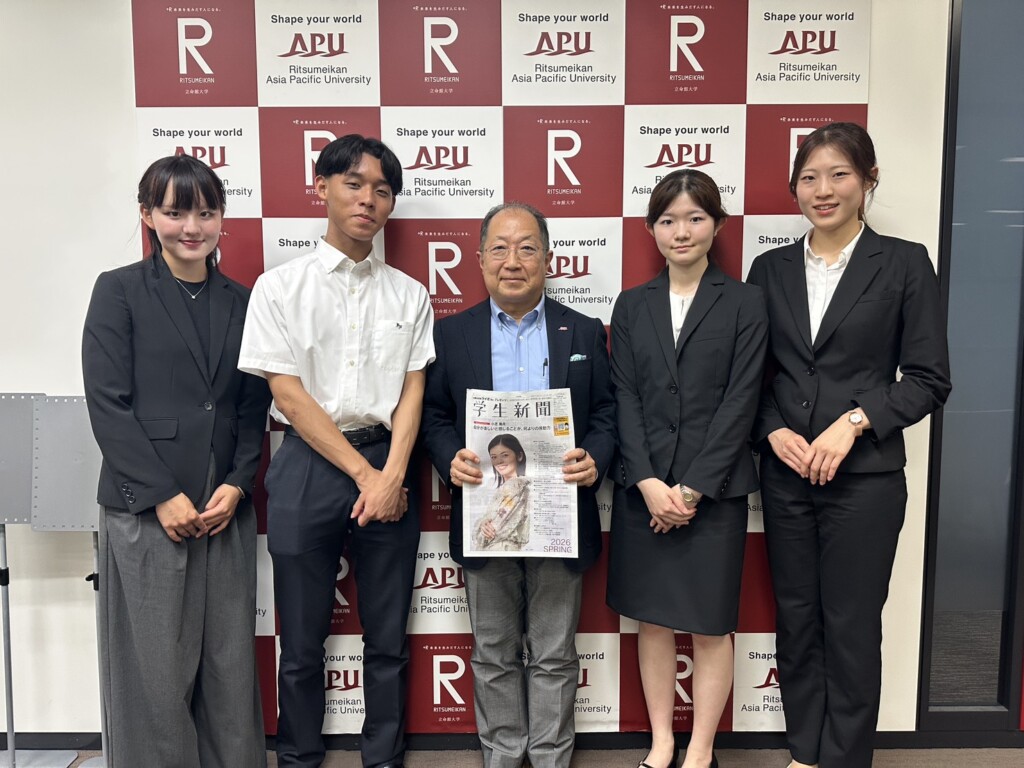
Mai Wakao, 4th year student at International Christian University / Rinne Furuya, 2nd year student at Kaichi Nihonbashi Gakuen High School / Risa Ukita, 3rd year student at Tokyo Woman's Christian University / Ayami Matsuyama, 2nd year student at Aoyama Gakuin University
List of related articles

Artist: Shinjiro Atae

Itabashi Ward Itabashi 10th Elementary School

Student newspaper October 2022 issue

Mori Trust Co., Ltd. President and CEO Miwako Date

Takahiro Takabatake, President and CEO of Z-Kai Educe Co., Ltd.

Special feature on 80 years since the end of the war

"OCEANS Feel So Good AWARD 2024" Winner Announcement Ceremony

No comments yet.