

House of Representatives member, Hajime Funada
I want you to look at the world and take on challenges without fear.
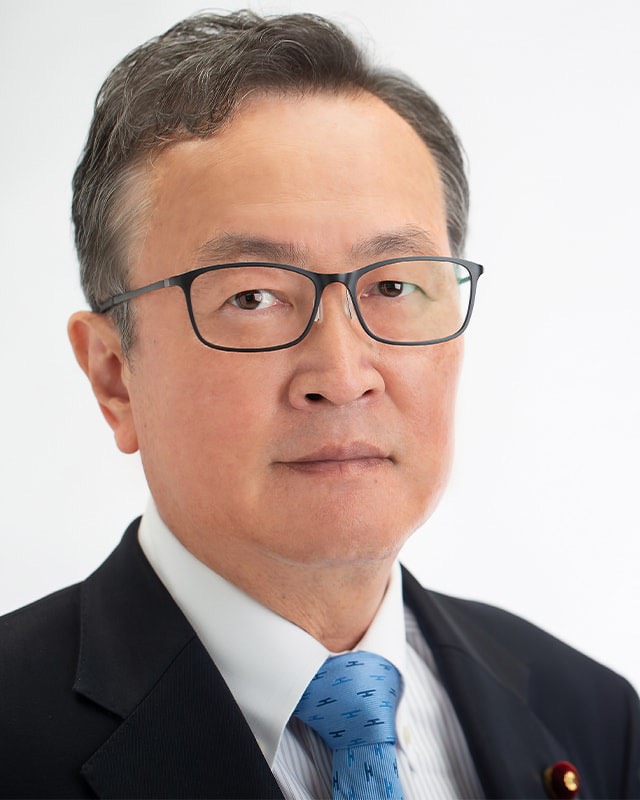
Hajime Funada, Member of the House of Representatives
■ Profile
Born on November 22, 1953, in Utsunomiya City, Tochigi Prefecture. Graduated from Keio University Graduate School. In 1979, he was first elected to the House of Representatives at the youngest age of 25. In 1992, at the age of 39, he joined the cabinet as Director-General of the Economic Planning Agency. He has served as head of the Liberal Democratic Party's Constitutional Revision Promotion Headquarters and chairman of the House of Representatives General Committee, among other positions. Representing Tochigi's 1st district, he was re-elected in the House of Representatives election in February 2026, completing his 15th term.
After graduating from Keio University Graduate School, Hajime Funada became a member of the House of Representatives after working as a teacher at Sakushin Gakuin High School. He has held various positions, including Minister of State for Economic Planning and Chief Justice of Impeachment Justice, and has worked on policies aimed at international contributions and the development of science and technology. In this interview, we spoke with Mr. Funada about his student days, what motivated him to become a politician, his current activities, and his outlook for the future.
During my student days, I lived a life that was half studying and half participating in club activities. At university, while studying economics and education, I enjoyed stargazing in a club called the "Stargazing Club." We would go to the suburbs where the stars were clearly visible and observe them. I also belonged to a student association made up of Keio University students from Tochigi Prefecture, and served as its president. Our activities included inviting music clubs from Keio University to Utsunomiya to hold performances. As a student, I had to sell tickets, and I experienced the difficulties of that. The experience of devising ways to get people to come to our events is still useful to me today.
After graduating from university, I became a teacher at Sakushin Gakuin High School. At the time, my grandfather, Funada Tanaka, was a member of the House of Representatives, and I thought my father would succeed him in the future. However, my father was serving as the governor of Tochigi Prefecture at the time, so he couldn't run for the House of Representatives immediately. That's when people around me suggested I run. I eventually decided to run and began my campaign. As a teacher, I was used to speaking in front of people, but talking about politics to adults was a different matter. I struggled to speak in a way that would be properly understood. However, people can grow with practice. With each experience, I gradually felt a sense of accomplishment. But even after nearly 40 years as a politician, I still don't think I've ever given a perfect speech. I believe that no one is ever 100% perfect, and I continue to strive for improvement.
The final deciding factor in my decision to become a politician was the presence of the secretaries who had supported my grandfather for many years. I had a strong desire to repay the kindness of those who had supported my grandfather. My father also warmly encouraged me, saying, "You should do it." It was this desire to live up to the expectations of those around me that motivated me to pursue a career in politics.
■ Supporting international contributions and the development of science and technology
Within my political activities, I focused on diplomacy and international contributions. This began when I took on a role in supporting the Japan International Cooperation Agency's (JICA) Japan Overseas Cooperation Volunteers. At the time, JICA was sending around 500 to 600 young people in their 20s to 40s to developing countries around the world each year. Since the deployment period is about two years, this meant that there were always around 1000 people working overseas. Later, there was talk of further increasing the number of volunteers, and I supported the initiative to expand it to a scale of 1000 people per year. In international contributions, I believe that it is important not only to provide funding, but also for people to actually go to the field and provide support.
In the field of astronomy, large telescopes from around the world are installed on the summit of Mauna Kea on the island of Hawaii. Japan was chosen to install a large reflecting telescope, and played a key role in its realization. Currently, plans are underway for the next large telescope, a concave mirror telescope. We are grateful to have been able to make such a significant contribution to the development of science and technology, including astronomy.
■ Addressing Science and Technology and Consumer Issues
One of the themes we are currently focusing on is science and technology. To support Japan's future, it is essential to strengthen basic research. We are working to increase the amount of Grants-in-Aid for Scientific Research, also known as KAKENHI, and to create a system that allows for flexible use over multiple years. What is especially important is "an environment in which young researchers can continue their research." We want to increase the opportunities for young researchers to take on research challenges, including relatively small-scale research grants, by ensuring that funding reaches them. If young people are not nurtured, the next generation of researchers will not emerge.
Furthermore, we are also addressing consumer issues. Consumer harm is very significant, and it is necessary to appropriately review the Consumer Contract Act, the Specified Commercial Transactions Act, and the Premiums and Representations Act in response to changes in sales methods and advertising. We have also been working to raise awareness of the consumer hotline "188 (Iya ya!)". In addition to resolving problems quickly after they occur, we believe it is important to prevent harm from occurring in the first place.
What I find rewarding about my work in politics is when I can fulfill the requests I receive from organizations and people in the community, and see their joy. These successful experiences give me a sense of getting closer to my goals and are the driving force that keeps me going.
■ To bring the voices of the younger generation to politics
What I particularly want to focus on going forward are social security issues such as healthcare, pensions, and long-term care. The younger generation will also reach old age in the future, and may find themselves responsible for caring for their parents. I want them to consider the state of social security as an issue that concerns their own future. And I hope this will lead to an interest in politics.
While older generations tend to have high voter turnout, younger generations tend to have low turnout. If young people go to the polls, politicians will be more inclined to consider policies that are relevant to younger generations. I have been involved in efforts to lower the voting age for national referendums and the voting age to 18. I have also worked to promote civic education in high schools by setting up early voting stations on universities and creating supplementary textbooks. I want young people to participate in politics not as something distant, but as something that directly affects their lives.
■Message to university students
I want all students to challenge themselves in everything they do. Don't hesitate to try new things, and take the first step towards anything that interests you. In particular, I strongly encourage you to try studying abroad. The number of Japanese students studying abroad has decreased to about half of what it used to be. Of course, this is partly due to the declining birthrate and overall decrease in population, but I feel that there must be some problem with the decrease in the number of students studying abroad. Please, try challenging yourselves in a variety of ways.
Interview with Student Newspaper Online on November 3, 2026, Haruna Shoji, a second-year student at Tokyo University of Pharmacy and Life Sciences
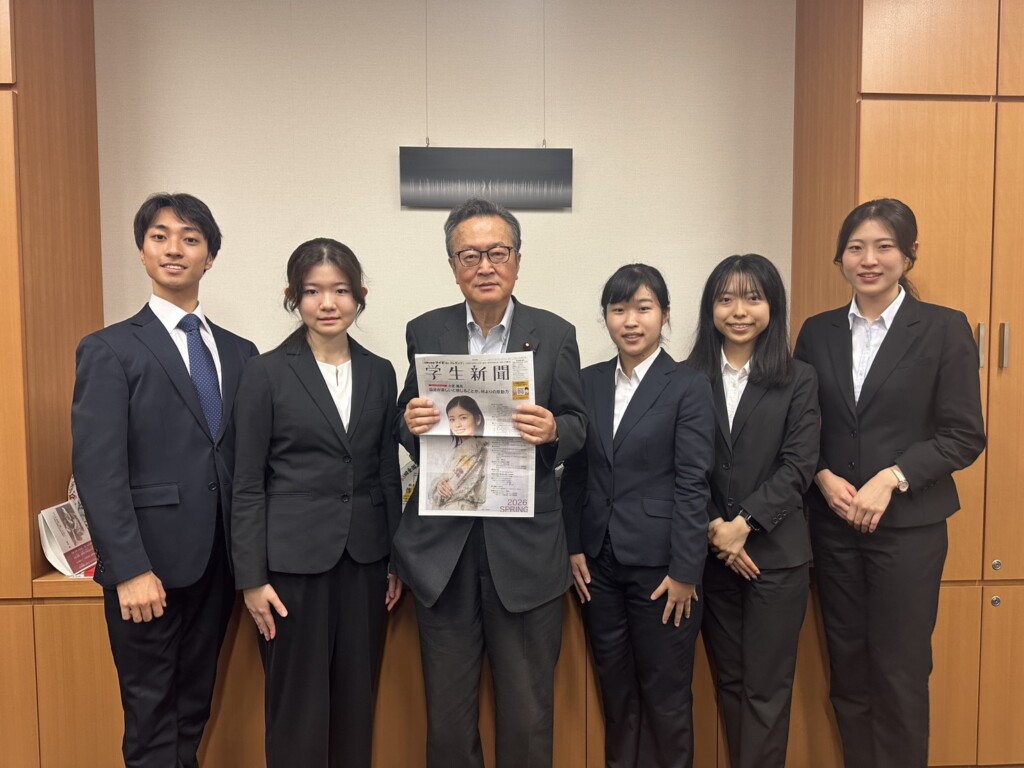
Kyohei Nakazawa (3rd year, Waseda University) / Emari Oike (1st year, Japan Women's University) / Haruna Shoji (4th year, Tokyo University of Pharmacy and Life Sciences) / Yurie Watanabe (3rd year, Josai International University) / Risa Ukita (3rd year, Tokyo Women's University)
List of related articles

Nitori Holdings Co., Ltd. Director and Executive Officer...

Skylark Holdings Co., Ltd. Representative Director...

Shin Ehara, President and CEO, Calbee, Inc.

The musical "Breaking Fruit" opens! The musical that has received a huge response in Korea...

Student Newspaper April 2022 Special Edition

GAKUSEI RUNWAY 2024 SPRING & SUMMER

Calbee, Inc. Marketing Division Digital Marketing...

No comments yet.